Structural engineer in Lafayette, LA

Lafayette sits in the heart of Acadiana, where a network of natural drainage canals including Coulee Mine, Coulee Fortune, and Coulee LaSalle channel runoff toward the Vermilion River. The parish has a documented history of localized flooding with as little as a ten-year storm event, and the area-wide drainage plan identifies undersized roadway cross drains and a lack of regional drainage design standards as ongoing challenges. Soils across Lafayette Parish are rated as limited for shallow excavations due to sloughing risk, and the humid subtropical climate brings hot summers and significant rainfall that keep soil moisture levels in constant flux. New residential and commercial development must include drainage impact analysis and site plans signed and sealed by a licensed engineer.

Call (601) 540-5109
Service Location

Lafayette, LA

TX Service Area

No extra travel fees for this area

Communities we serve

Lafayette Broussard Youngsville Carencro Scott Breaux Bridge New Iberia Opelousas
  • Serving Dallas, TX since 2015
  • Signed and Sealed Reports
  • Texas to Georgia Coverage
  • Lender-Ready Documentation
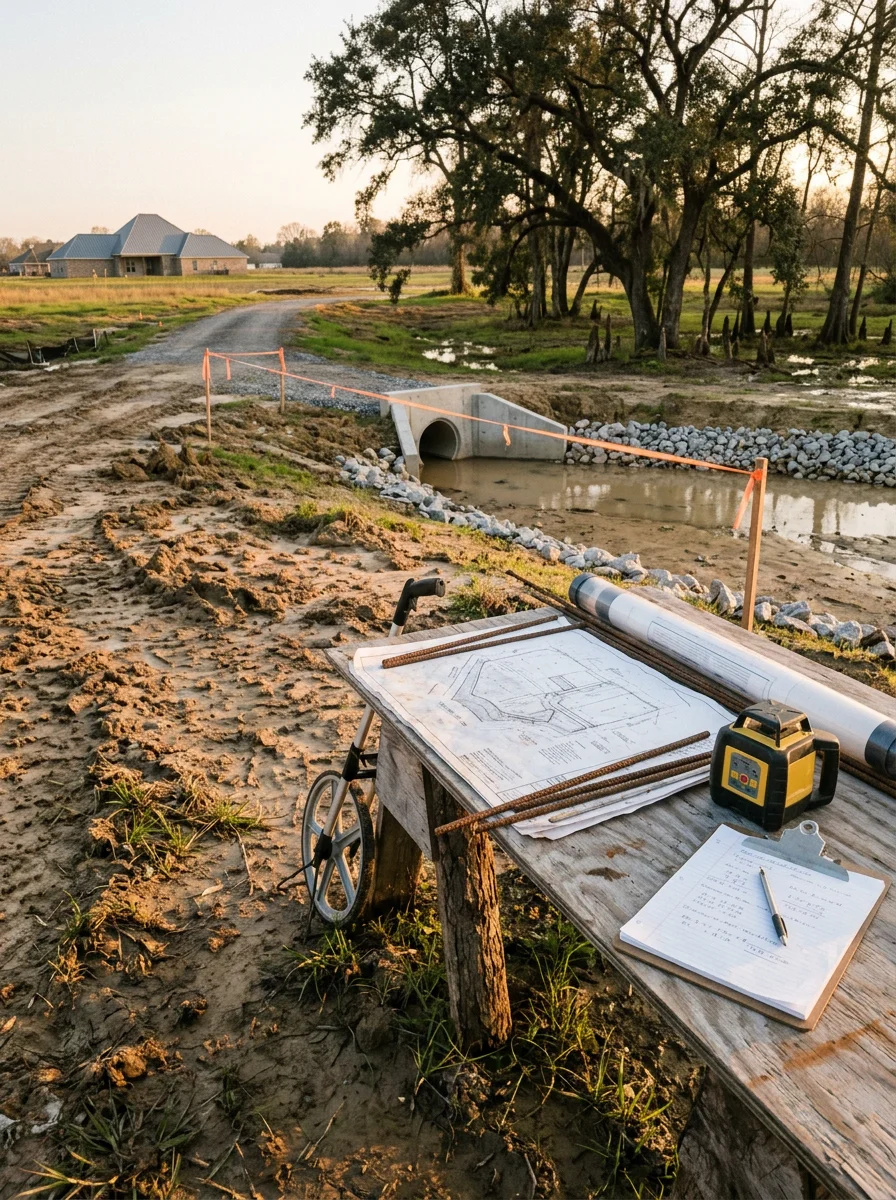
A grading and drainage design drawing for a Lafayette Parish development site, showing proposed detention pond location, drainage servitudes, and stormwater flow paths.

Lafayette, LA

Structural Engineer

Lafayette Drainage Servitudes and Coulee Systems Require Civil Precision

Lafayette's drainage infrastructure relies on a network of canals and servitudes that cross private property throughout the parish. Building within or near a drainage servitude is typically prohibited, and site plans must clearly show the location of any servitudes on the lot. Missing a servitude on a site plan is one of the most common reasons applications are rejected by the Lafayette Consolidated Government Department of Development Services. A civil engineer familiar with Lafayette Parish drainage mapping can identify servitude locations and design the site layout to avoid conflicts before the submittal.

The Lafayette Parish area-wide drainage plan identifies a lack of consistent regional requirements for drainage design as a core problem, and the parish has moved toward requiring 25-year detention for all commercial and residential developments. That means new site plans must include detention pond design or equivalent stormwater management that holds runoff on site long enough to prevent downstream flooding. Grading and drainage design that meets this standard requires hydraulic modeling and a drainage impact analysis, both of which must be signed and sealed by a licensed engineer.

Lift station design is a practical need on flat Lafayette Parish lots where gravity drainage to the nearest coulee or drainage pipe is not achievable. A lift station pumps wastewater or stormwater from a low point to a higher elevation where gravity flow can continue. The design must account for the flow volume, the pump capacity, the force main routing, and the electrical and mechanical systems that keep the station running. This is a civil and MEP engineering task that requires a signed, sealed design before the parish will issue a permit.

At a glance

  • Serving Dallas, TX since 2015
  • Free written estimates with no obligation
  • Premium options most contractors don't carry — we explain the differences honestly
  • Responsive scheduling and clear communication from estimate to completion
Call (601) 540-5109

Every service, available in Lafayette, LA

Site plan and civil engineer design is the primary service need in Lafayette because the Lafayette Consolidated Government requires signed, sealed site plans for residential and commercial development, and those plans must address drainage servitudes, flood zone status, and stormwater management. Grading and drainage design is equally central: the parish area-wide drainage plan identifies inadequate detention volume and undersized drainage infrastructure as top concerns, and new development must provide detention for design storm events. Lift station design is relevant for sites where gravity drainage is not feasible, which is common on flat Lafayette Parish lots. Subdivision design and road design round out the civil scope for larger development projects across the parish.

What Lafayette, LA customers say.

Worked with us?

Leave a Review

Serving Lafayette, LA

Free on-site estimate. No commitment required.

Our crew knows Lafayette, LA. We will show up on time, assess the job honestly, and give you a clear written number before asking you to decide anything.

Call (601) 540-5109

Structural Engineer FAQ for Lafayette, LA

Common questions from Lafayette, LA customers about our services, process, and coverage.

A Lafayette Parish site plan submittal must include existing and proposed drainage area maps, the location of any drainage servitudes on the lot, proposed elevations consistent with the drainage impact analysis, and identification of existing water and sewer infrastructure. The site plan and drainage impact analysis must both be signed and sealed by a licensed civil engineer in the state of Louisiana. The Lafayette Consolidated Government Department of Development Services reviews the submittal for compliance with the Unified Development Code before issuing a permit.

A lift station is needed when a site's elevation or distance from the nearest gravity drainage or sewer connection makes gravity flow impossible or impractical. On flat Lafayette Parish lots where the finished grade is at or below the elevation of the receiving drainage system, a lift station pumps flow to a point where gravity can take over. The design must specify pump capacity, force main size and routing, wet well volume, and the electrical and mechanical systems required for reliable operation. A signed, sealed lift station design is required as part of the permit submittal.

A drainage impact study documents how stormwater currently moves across and off a site, calculates runoff volumes for design storm events, and demonstrates that the proposed development will not increase flood levels on adjacent properties or in the downstream coulee system. Lafayette Parish requires this analysis for new development because the area-wide drainage plan identified inadequate detention and undersized drainage infrastructure as top concerns. A study that shows the project meets detention requirements protects the owner from permit rejection and from liability if downstream flooding occurs after construction.

Still have questions?

Call us directly. Real answers, no scripts.

Call (601) 540-5109

Proudly Based in Dallas, TX

Stop by, call, or book online — we're always nearby when you need us.

Hours

  • Monday 8:00 AM - 5:00 PM
  • Tuesday 8:00 AM - 5:00 PM
  • Wednesday 8:00 AM - 5:00 PM
  • Thursday 8:00 AM - 5:00 PM
  • Friday 8:00 AM - 5:00 PM

Schedule a Free Inspection